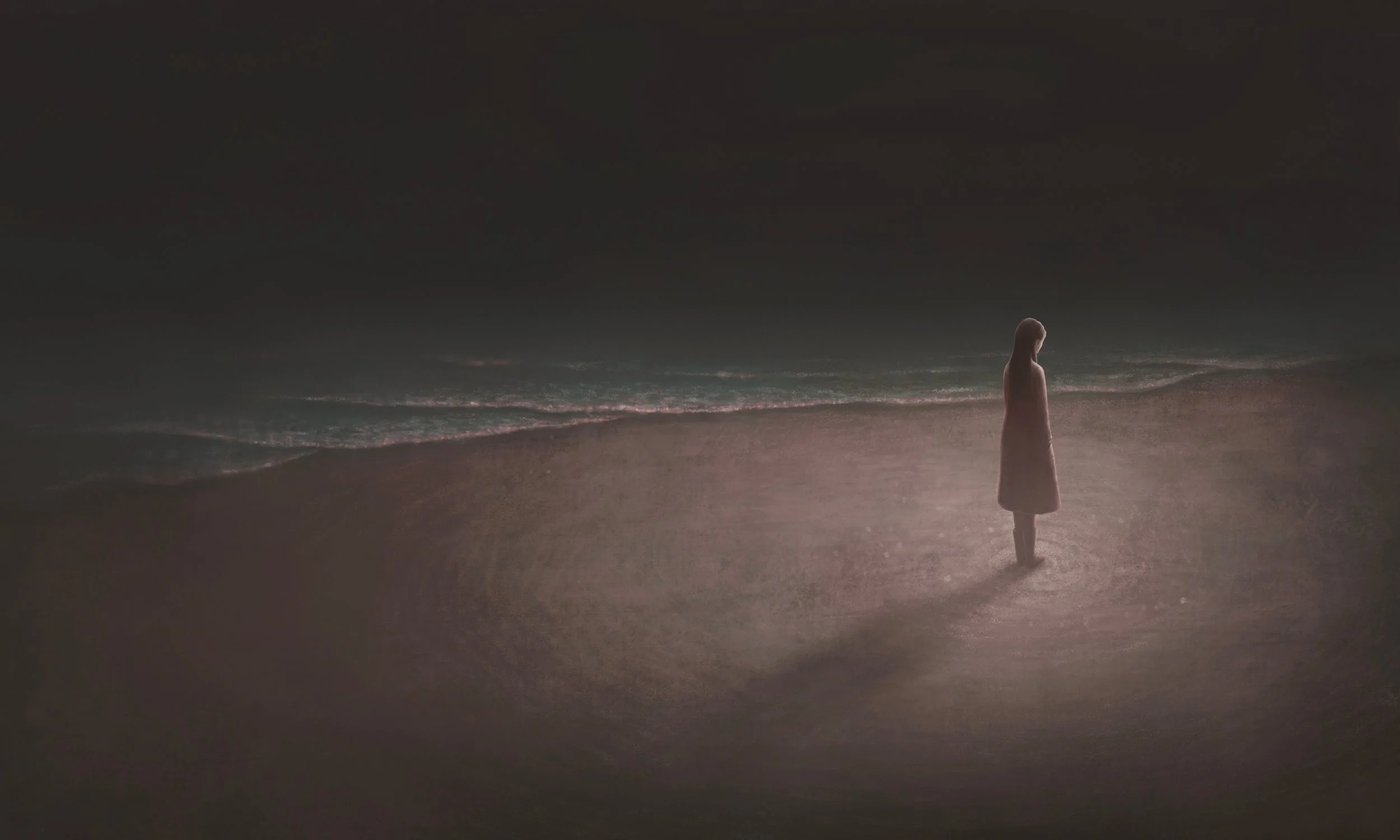
Emily sat on the beach with her hands folded over her belly. It had been twelve days and two hours of wondering whether anyone was coming for her and her last sliver of hope was beginning to wane. She had removed the life vest on day four, only after it occurred to her that it would make a suitable pillow for the short and balmy nights. The smashed up handheld radio that washed ashore with her had stopped crackling almost instantly, so she had given up shouting messages into it and was now using it to dig for pearlescent lavender seashells to string into necklaces. She was not starving—there was in fact a small pool of fresh water about a half-mile inland and she and the baby had been perfectly content eating bugs, half-rotten coconuts, and one flopping fish dropped at her feet by a careless gull. However, she worried that this good fortune of sustenance may at some point run dry and she was becoming more desperate by the day for a Diet Coke.
She shielded her eyes from the sun with one flattened hand and scanned the water, as she did most hours of most days, looking for boats or small planes. From atop her pile of fronds, she liked to imagine who would be the first to arrive: a clean cut crew of Coast Guardsmen in starched blue button downs, or a little old fisherman with a white scrub-brush beard. Perhaps a band of Somali pirates who she would be able to sweet talk out of taking her prisoner and raping her due to her condition, a group she could instead climb the ranks through and sail them all, quite heroically, to a cruise port in Galveston or Miami where she could pop out the baby and then check into a clean hotel.
As she tried to work out how she could win over such a crew, something approaching the shore caught her eye. At first she thought it was a piece of litter, and her heart leapt at the thought of some careless person nearby tossing their trash into the pristine ocean. But then she saw that bobbing in the waves was no scrap of miraculous plastic, but rather a little glistening gray beak. She squinted and craned her neck from her leafy seat. Her entire life, she had prided herself on never requiring glasses, but in truth she sort of did need them and simply felt they didn’t agree with the shape of her head. Thus, when a sleek, wet creature emerged from a bouquet of white foam, it was both startling and hazy. Emily jolted and the baby kicked her in the ribs.
Emily had been particularly invisible in school. Not tormented or teased and therefore, admittedly, much better off than many. But she tended to wilt into herself like a thirsty fig tree before those she believed to be superior: sculpted girls with velvety eyes who stood an entire head taller than her; boys with flaxen shags who loosened their ties after the last bell of prep school; artists and athletes; cheerleaders and decent-looking stoners; anyone with rich parents or straight A’s or a car or skateboard.
It was perverted, she knew, how obsessed she was with them. She felt ashamed for being unable to stop fantasizing about what it would feel like to be inside other peoples’ lives. How she had longed to know what the leather passenger seats of their Chryslers smelled like or to move with them in a pack through the mall to try on sugar-frosted prom dresses.
And yet there was, at times, a tiny, delicious comfort at the heart of her isolation. The flame of Yearning, enduring as a pilot light somewhere deep within the pit of her. There was something almost romantic, she thought, about the particular gloom she felt on Sunday evenings, staring out her little bedroom window onto the foggy suburban street, flicking chips of peeling paint from the windowsill with her fingernail. The throbbing melancholy mitigated by the rest of her life, everything, stretched out right in front of her. To be Old and Sad is depressing, but to be Young and Sad can actually be quite fashionable. Her sadness, she had decided, was the literary type and she was going to suck on it like a Lifesaver until it was gone.
The blue dolphin had dipped quite quickly back into the sea, sending bubbles through the water with a swish of its mermaid tail. Emily was almost convinced she had imagined it, probably a hallucination from glucose deprivation, when it resurfaced even nearer to the beach. It was so close, she thought she could probably hit if she had a tennis ball, and then felt bad for imagining that as a unit of measuring distance. She tried to remember a time she had ever been in such proximity to a wild animal but could only conjure squirrels and birds and other creatures that barely seemed animate. It swam closer, curiously blinking its sparkling black eyes and cocking its head.
I can’t keep you as a pet, she thought. I can’t have another mouth to feed.
But it only came closer and then stretched 100 gleaming little pointy teeth into a smile and she felt that she loved this animal very much.
And then, the baby began flopping around inside her in a way that made her moist and queasy. She leaned back into the shade of a palm and squeezed her eyes shut and asked it to stop.
It was not to say that Emily didn’t have friends. There was Peter Peebles, who sat next to her in art class and drew comics of their teachers and classmates with ghoulish, exaggerated eyes and crooked cemetery teeth that made her laugh and laugh. And Peggy Liu who shared half her class schedule and was sunny and kind if not a little boring and clingy.And of course Elizaveta, Lizzie, her one and true best friend from the moment they met on the
bus in Eighth grade. Lizzie, with a glittering face the color of the moon. The only cold feet she would allow to rest on her underneath the comforter while they dissected, in depth, every thought that had ever crossed their minds. Whose green apple shampoo wafted from her damp hair in morning study hall and whose car she had spent what felt like a third of her life in, cruising through the empty downtown, squeezing out the very last minutes of their curfew like toothpaste because there was nowhere they’d rather be than with each other. She loved her like a mother and a daughter and a sister; every earthly female urge to care activated through thousands of small acts of love passed back and forth like slices of birthday cake. She wanted to run hand in hand with Lizze through a tangled thicket of wisteria. To marry her and make her doctors’ appointments and talktalktalk until the coffee grew cold. To curl up inside her womb so she could ride along for everything she did and taste everything divine and sweet that passed through her lips.
And then, one day, she woke up and Lizzie was still her friend–still her best friend–but now her best friend with a boy husband and two daughters in braids with Catholic middle names. And here was Emily in her position, which Lizzie was kind enough to be cheerful about, but which wasn’t at all the same. And as they stared at each other over mugs of tepid Lipton tea, it passed telepathically between them that they would never be the most important people to each other again, and that was that.
When Emily opened her eyes, her companion was gone. The sun was hanging low in the sky now, fat and orange and skimming the waves. She knew she should probably make her way to her pool and scoop a half coconut full of fresh water to sip before nightfall, or start thrashing together sticks for the state of the art crab trap she was devising. But she felt glued to her stack of palm leaves, an inexplicable attachment to what had just happened nagging her to stay put. It had to be a sign, she thought, a creature of such intelligence showing an interest in her. She had once read an article in National Geographic about a dolphin who fell in love with the female scientist studying him, and perhaps that was what was happening here. She could hardly blame it – she was enormous but had developed quite a lovely tan over the past two weeks and the saltwater was doing nice things for her hair. It would go fetch someone to come get her because it loved her so much– would do flips and dolphin sign language for a Carnival cruise ship captain who would pull her aboard in a dinky lifeboat and give her a single glass of cold sauvignon blanc, because most people agreed that was allowed now. She could call Lizzie, who had likely been trying to reach her, to text her a picture of the girls and ask how she was feeling.
She could finally see what photo they picked for her Missing Poster.
As dusk settled over the beach in a cloudy, purple glow, Emily pushed herself up with her hands and stretched her back. She would collect her drinking water and swallow it slowly, savoring the metallic sweetness of the earth it carried while she watched for the arrival of her salvation. She nestled her arm in the crook between her breasts and belly and could feel that the baby was already asleep, barely stirring within. She moved slowly across the sand so as not to wake it.
Maria Biggs is a writer and television producer living in New York City. Her work has been recognized by The Austin Film Festival and The Thurber House.