Great artists never die.
A quite literal statement in regards to our small town and its most celebrated son, the legendary performance artist Leopold von Tigre, the same performance artist who once tricked the then Prime Minister into climbing into a bathtub full of bovine effluent on live television.
A month or so into my tenure as mayor, von Tigre bundled his way into my office unannounced. By this time, he was a grotesquely fat, ruddy-cheeked, yet still robust man of ninety-three, rather than the flamboyant manic dynamo of his youth. I don’t mind admitting that he completely terrified me. Not just because his raucous reputation preceded him, or that he was an incredible force of nature, even then, but because he tossed a stuffed crocodile in my direction: ‘A gift, a gift, dear boy,’ before slumping down in the visitor’s chair.
“I fear the end is near,” he bewailed, taking a silken handkerchief from the top pocket of his smoking jacket and mopping his brow with a theatrical flourish. “I fear the final bell is about to toll, I feel my old man’s feet slipping off this mortal coil.”
I felt it only polite to protest and tell him that he surely had many a good year left in front of him, but as soon as I opened my mouth, he raised a hand gesturing for silence.
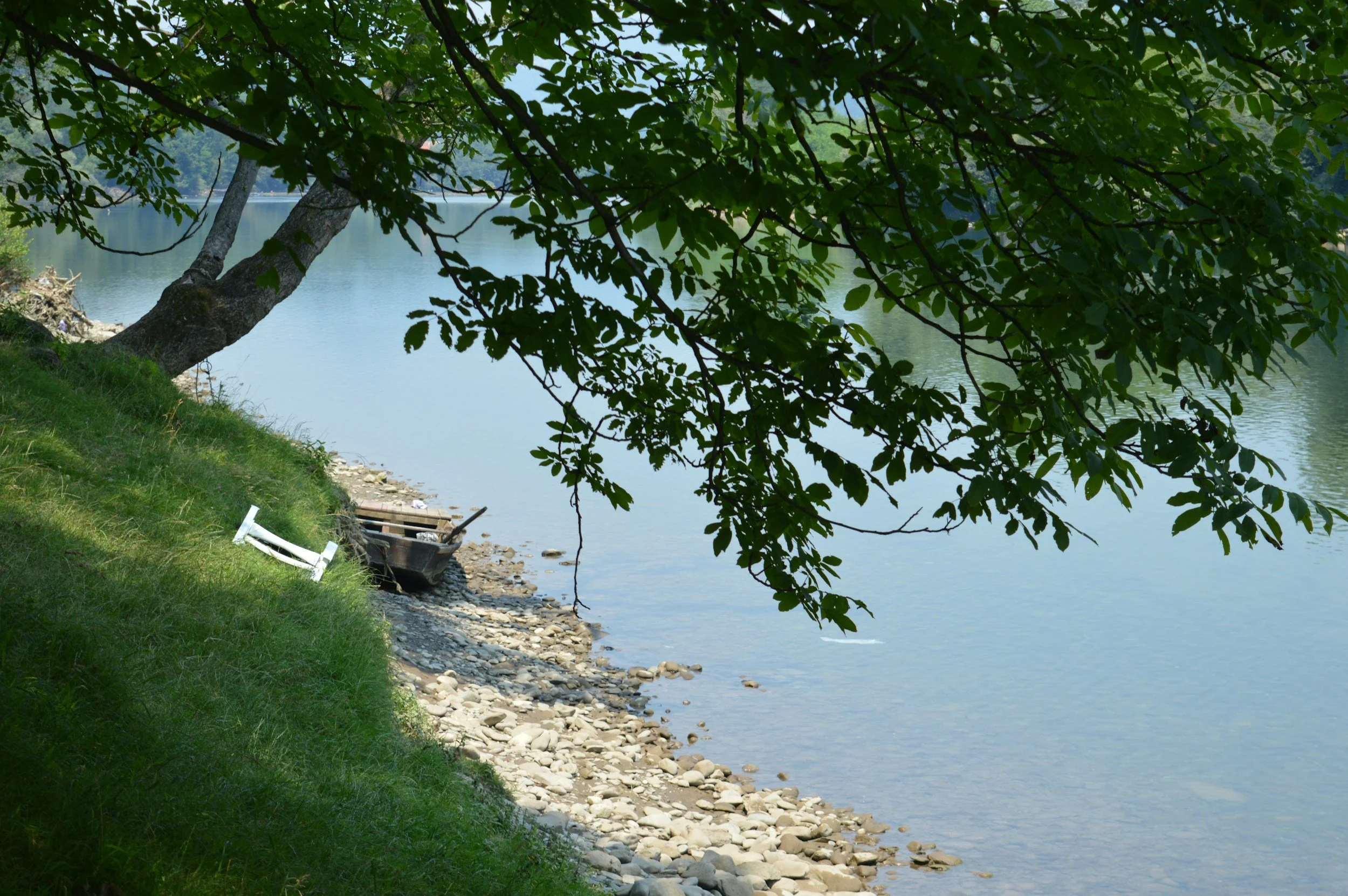
“Let me speak, dear boy. I come to you with a most solemn request. As you know, I chose to spend the twilight of my years in my hometown, scene of my fondest childhood memories. The forest. The mountains. The beautiful olive-skinned women. And most of all, the banks of the river, where I have spent many a fine sunny hour since my return, contemplating my mortality.
“Now, as I edge ever closer to drawing my last breath, I would like nothing more than to drift into eternal sleep in the very place where I breathed my first.”
“I understand completely, Signor von Tigre. Anything you require for your funeral arrangements, you need only ask. I, personally, am at your service. You’ve done so much for the town and the entire region over the years. It would be a great honour to give you a full parade and –”
“No, no, no.” He waved my well-meaning words away. “You must listen carefully. I have a somewhat unusual and no doubt controversial request. From an early age I had but two terrible fears in life – enclosed spaces and fire. I could never, therefore, under any circumstances, contemplate a standard burial in the ground or a cremation by flame.”
Had I not been too scared to speak at this point, I still don’t think I would’ve quite known what to say.
“For those compelling reasons, I want a most unconventional service. I would like to be laid on the banks of my beloved river and left to simply decompose.”
“Decompose?”
“That’s right, dear boy. It’s the most natural and poetic death of all, if you really think about it. To lie down for eternal rest amongst all God’s creations and slowly fade into nothingness. I care not if any frisky creature drags me to its lair and devours me limb from limb. Or if the rains fall and sweep me into the depths of the river itself. I want this to my last ever performance and for elements completely out of my control for once to do with me as they will.”
There were a few moments of incredibly awkward silence. Von Tigre was breathing heavily, as if his lengthy, involved, not to mention certifiably crazy speech had taken much out of him. I had no idea what to tell the man. There were any number of reasons why I simply had to refuse his request: the health and safety aspect alone made my position impossible.
“Signor von Tigre,” I began slowly but with purpose, “I’m terribly sorry, sir. But I don’t think there’s any way we can accommodate your request. I don’t think –”
“I thought you would say that, dear boy,” he talked over me. “All I ask is that you put it before the people.”
“The people?”
“Yes, call a town meeting and take a vote.”
The following evening, the most prominent members of the local community gathered at the town hall to discuss the matter of von Tigre’s final resting place. Rather than meet with the outright horror and blanket refusal I had fully expected, the hall was split into two main factions, split down the middle, in fact. So outrageous had the artist’s performances been over the years – the taxidermized turkeys, rancid milk deliveries, and circumcision reversal debacles – he had been solely responsible for putting the town on the map. More and more tourists flocked here every year just to see the place the famous performance artist was born. There was a small museum dedicated in his honour, a statue, even an eatery and coffee shop called ‘Leopold’s’ and ‘The Performance Artist’ respectively. If it wasn’t for von Tigre, we wouldn’t be as nearly as prosperous as we were. And the local people, especially those with inns or guesthouses, appreciated that greatly.
“It would be a grave sin if we were to deny him his dying wish,” said Marie Strasser, proprietor of the coffee shop bearing von Tigre’s name. “He’s more or less provided us with a living for the last fifty-odd years.”
“If ole Leopold wants to be laid to rest above ground,” said my predecessor, Gunner Frey, “then who are we to argue?”
“Besides,” said local magistrate Angela Ferkel, “it’s not as if he’ll be there for long.”
The naysayers were just as emphatic in their disapproval of the plan. They couldn’t believe we were even considering such a macabre proposal, no matter how lofty a personage von Tigre may be.
“This is outrageous!” cried Beatrice Schinner, a local government official. “We can’t let a dead body simply rot in the streets.”
When the votes were counted up it was a tie. The deciding vote came down to me and me alone. A lose-lose situation, whichever way I voted I would alienate half the town, effectively ruling out any chance of re-election. But having spoken to the man himself and knowing what he meant to the people, I decided to do the unthinkable and grant the great artist his last wish: an open-air funeral with a difference.
As if prescient of the outcome of our deliberations, von Tigre died the very next evening after, what I’m led to believe, was a debauch of epic proportion, a Caligula-style orgy involving three cases of champagne and two dozen of the local bordello’s most alluring women (for which, in all fairness, it is widely renowned). At the scene, the chief medical officer stated the cause of death as ‘massive cardiac arrest’.
Knowing that we had to put certain preliminary measures into place before we laid von Tigre’s body literally at the side of the road (or riverbank), we posted notices all over town, informing residents of the decision we had taken. This included a few provisos, that the body shouldn’t be touched, that people were not allowed to go within a certain distance, a physical cordon sanitare, if you will, and that we would post guards, on a twenty-four-hour rolling shift basis, to watch over the body, and ensure it wasn’t tampered with.
Unsurprisingly, news of such an unorthodox funeral for an artist of von Tigre’s repute spread far and wide. On the morning we laid him to rest, hundreds, if not thousands of visitors descended upon the town, most of whom (and this had crossed my own mind on more than one occasion) assumed this was yet another of the artist’s legendary performance pieces, his last and greatest contribution to an already incredible legacy. Hence, many people were poised with cameras hoping to capture the moment the aged old man jerked back into life at the most unexpected juncture.
“You’re one hundred per cent certain he’s dead?” I asked the chief medical officer with no little force. “You’re not in cahoots with him, are you? This isn’t some kind of trick?”
“No, no, Mr Mayor, sir. I assure you. The great Leopold von Tigre has breathed his last. From the preliminary tests I carried out, the arterial walls ruptured so violently during his final drinking binge, he died a moment or two after cardiac arrest. There is no way he can be alive.”
Despite my reservations, the day turned into a true celebration of the great man’s life. Once his body had been respectfully laid on the riverbank, we, as a community indebted to his services, raised a glass or two to his memory. Street vendors set up stalls all over town serving food and drink. A band comprising of von Tigre’s favourite local musicians played traditional songs until late into the evening, we had a firework display on the opposite bank of the river, which lit up the night sky in suitably spectacular fashion. All of which made for one of the most memorable and enjoyable nights in our small town’s history.
In the coming days, there were no reported incidences involving von Tigre’s corpse, other than the regularity in which the guard on duty had to remove the copious amounts of bird waste which landed on the body throughout the day (we were all in consensus about not letting the corpse be defiled in this manner). Gradually, less and less visitors appeared to take pictures and pay their last respects to an artist who meant so much to so many people. To all intents and purposes, we felt that the whole event had been carried off in a dignified and successful fashion.
A week after the funeral, however, the chief medical officer visited my office to voice a most curious concern.
“Mr Mayor, I visited von Tigre’s corpse today, as per your instructions, and noticed the most unusual anomaly.”
“And what might that be?”
“There are absolutely no signs of putrification. In the normal scheme of things, a dead body, especially that of a man in advancing years, changes to skin colour and an unpleasant odour would be discernible in a matter of two or three days. More to the point, it’s the height of summer, temperatures have been high throughout the day and night. In the circumstances, therefore, this is highly irregular.”
I told him to monitor the situation and continue to update me on a daily basis.
Each day, his report was exactly the same – no signs of putrification whatsoever.
On the fifth day, over a fortnight after we’d laid his body to rest on the riverbank, I decided to visit the site myself. The most peculiar of spectacles – von Tigre’s corpse looked exactly the same as it had during the funeral celebrations.
“Is there any kind of precedent for this type of thing, Doctor?”
“Only in the Holy Scriptures; saints’ whose earthly flesh was incorruptible, those who went on to be beatified. In a strictly medical sense, this is an impossibility.”
Both worried and suspicious, I called in a medical professional from an adjoining town and asked him to carry out a full medical examination of the corpse, just to ensure that he was indeed dead.
“No pulse, no vital signs, the skin is as cold as the…I was going to say the grave, but that doesn’t feel appropriate in the circumstances. Make no mistake, Mr Mayor, this man has been dead for weeks.”
When news of what one headline called ‘The Beatification of an Artist’ started to circulate way beyond the town and its environs, we were once again overrun with visitors to the site. Each and every hotel and boarding house within a fifty-mile radius were booked to capacity. We had to call in militia from the city to help us police the streets and uphold order. The clamour, not just for photographs, but religious pilgrims, the sick and infirm, who wanted to touch the ‘holy’ body of a man God had preserved from decomposition, was great and often unruly.
Ever opportunistic, local businesses produced all kinds of von Tigre related souvenirs and memorabilia – commemorative T-shirts, key rings, tankards, coasters, the local chocolatier even started to make corpse-shaped chocolate treats. It was a time of great activity but also great uncertainty. Rumours, some more fanciful than others, began to gain pace and colour. Most prevalently, that von Tigre had had his body coated in strong embalming fluid to ensure that his skin didn’t corrupt, not unlike the process communist leader Vladimir Lenin undergoes to this day. But when I had experts take a skin sample for analysis, the results came back as negative.
“We can find no traces of any embalmment, Mr Mayor.”
With all the furore in the press, it was only a matter of time before a representative from the highest church authority in the land came to pay our town a visit. Warned in advance, surviving members of von Tigre’s family barged their way into my office and made quite a scene. As their ex-husband (three ex-wives were to be counted amongst their extensive entourage), father, uncle, cousin was a confirmed atheist, they refused, most vehemently, to allow the Church to take control of the situation and try and associate von Tigre with some kind of religious miracle.
“He would quite literally turn in his grave,” said ex-wive number two, “if any priest or cardinal used his death to promote the unlikely cause of the unlikely cloud dweller.”
Red-faced and suitably chastened, the Holy man swiftly departed both office and town.
After six months, there was still not the slightest sign of decomposition; von Tigre’s body simply lay on the riverbank, peaceful and serene as it had been when we laid him to rest.
Interest began to wane.
At our next monthly town meeting, we discussed the matter at length but could come to no real consensus. Though I must state for the record, no serious consideration was given to removing the body altogether. It had become not just a tourist attraction and cottage industry, but a place of great significance to the townsfolk now. If anybody ever felt down or depressed, they sat on a bench overlooking both von Tigre and the river, and within a few minutes their minds miraculously eased of their burdens.
As such, we commissioned local tradesmen to erect more benches along that bank of the river. Soon people were walking past the body, in rain or shine, as if it was the most natural thing in the world, as if von Tigre was a statue or monument or, as perhaps was closer to his own final wishes, one of the trees that lined the banks of the river, a part of the natural landscape.
As fully expected, I failed to gain a majority in the next mayoral elections and duly left office after serving only one term. To my enduring pride, however, I will forever be synonymous with the decision to lay von Tigre to rest in such an unusual manner, the firework celebration, and the finest day in the town’s history.
If great artists never die, it is perhaps to ensure that ordinary, everyday people can live. And every time we venture down to the river and look at the incorruptible slab of human flesh that was once the legendary Leopold von Tigre, we are reminded of that in the most beautiful and profound way imaginable.
Neil Randall is a novelist, screen, and short story writer. His latest book, A Dark Day in the White City (Next Chapter Press) was released in April of this year. His shorter fiction and poetry have been published in the U.K., U.S., India, Australia, and Canada. Further news and samples of his work can be viewed at: https://narandall.blogspot.com/, including links to his new online review show Randall Reads…where the author reviews a book each week that made a big impression on him, and help shaped him as a writer.